One Wasserstein criterion, two methods reinvented
Independent Component Analysis (ICA) is a mature field. Since FastICA, source separation has relied on maximizing non-Gaussianity through carefully designed contrast functions such as kurtosis, negentropy or log-cosh. Their effectiveness, however, depends on how well the chosen contrast matches the source distributions.
In a recent preprint with Félix Laplante and Pierre Humbert, we replace these contrasts by a single quantity: the squared 2-Wasserstein distance to the standard Gaussian, \(W_2^2(Y,\mathcal N(0,1))\).
Under the standard ICA assumption that at most one source is Gaussian, we prove that mixing independent standardized sources strictly decreases the total Wasserstein non-Gaussianity. Consequently, the unmixing matrix is the unique population maximizer (up to signed permutation).
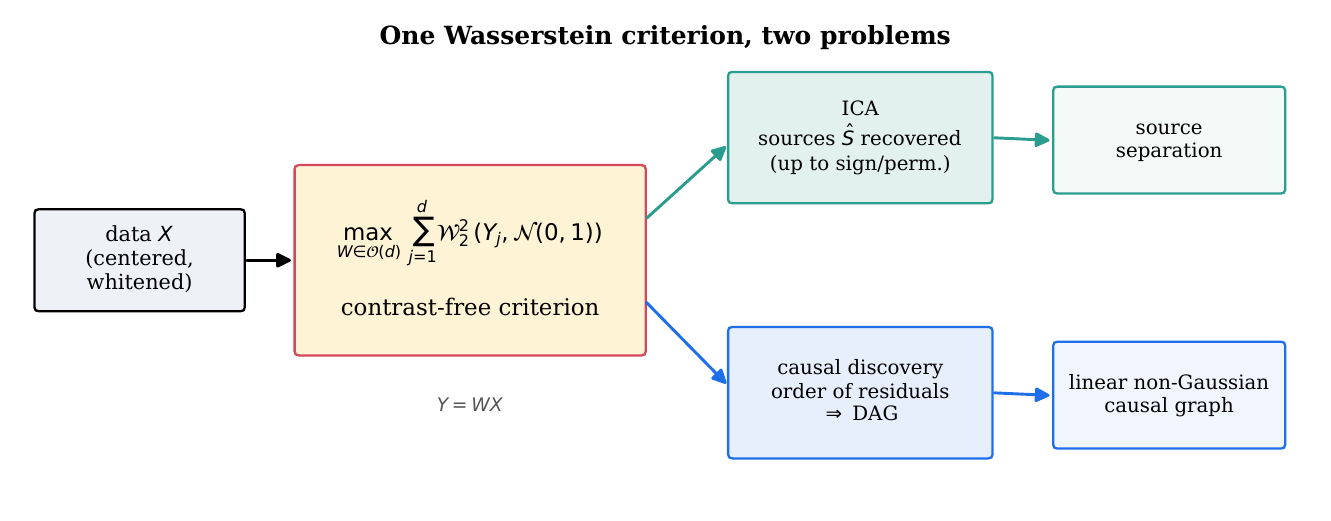
More importantly, the same optimization criterion,
\[ \max_{W\in\mathcal O(d)} \sum_{j=1}^d W_2^2(Y_j,\mathcal N(0,1)), \]
unifies two classical problems.
Interpreting the maximizer as an unmixing matrix recovers the independent sources. Interpreting the ordering of least-squares residuals recovers the causal order. Source separation and causal discovery therefore emerge from the same contrast-free principle.
The paper also introduces practical algorithms together with finite-sample consistency guarantees. The implementations are available as two scikit-learn-compatible Python packages: otica (GitHub) for Optimal Transport ICA, and otlingam (GitHub) for Optimal Transport LiNGAM.
Preprint: https://arxiv.org/abs/2607.12832