d-separation and Markov equivalence
Lecture 2 — Causality and Graphical Models
Three elementary structures
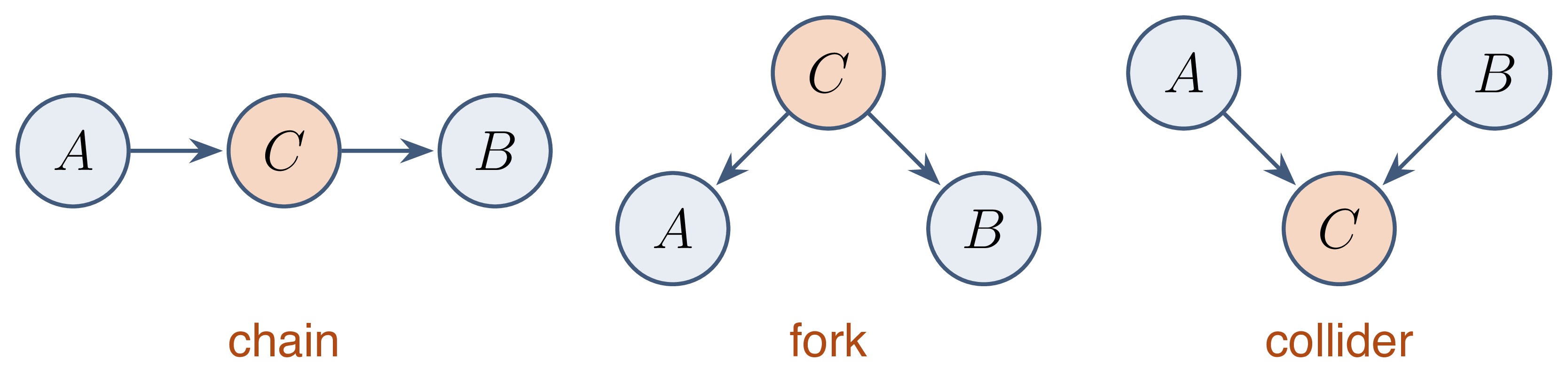
| Structure | Marginal | Given \(C\) |
|---|---|---|
| chain \(A \to C \to B\) | \(A \not\perp B\) | \(A \perp B \mid C\) |
| fork \(A \leftarrow C \to B\) | \(A \not\perp B\) | \(A \perp B \mid C\) |
| collider \(A \to C \leftarrow B\) | \(A \perp B\) | \(A \not\perp B \mid C\) |
Explaining away
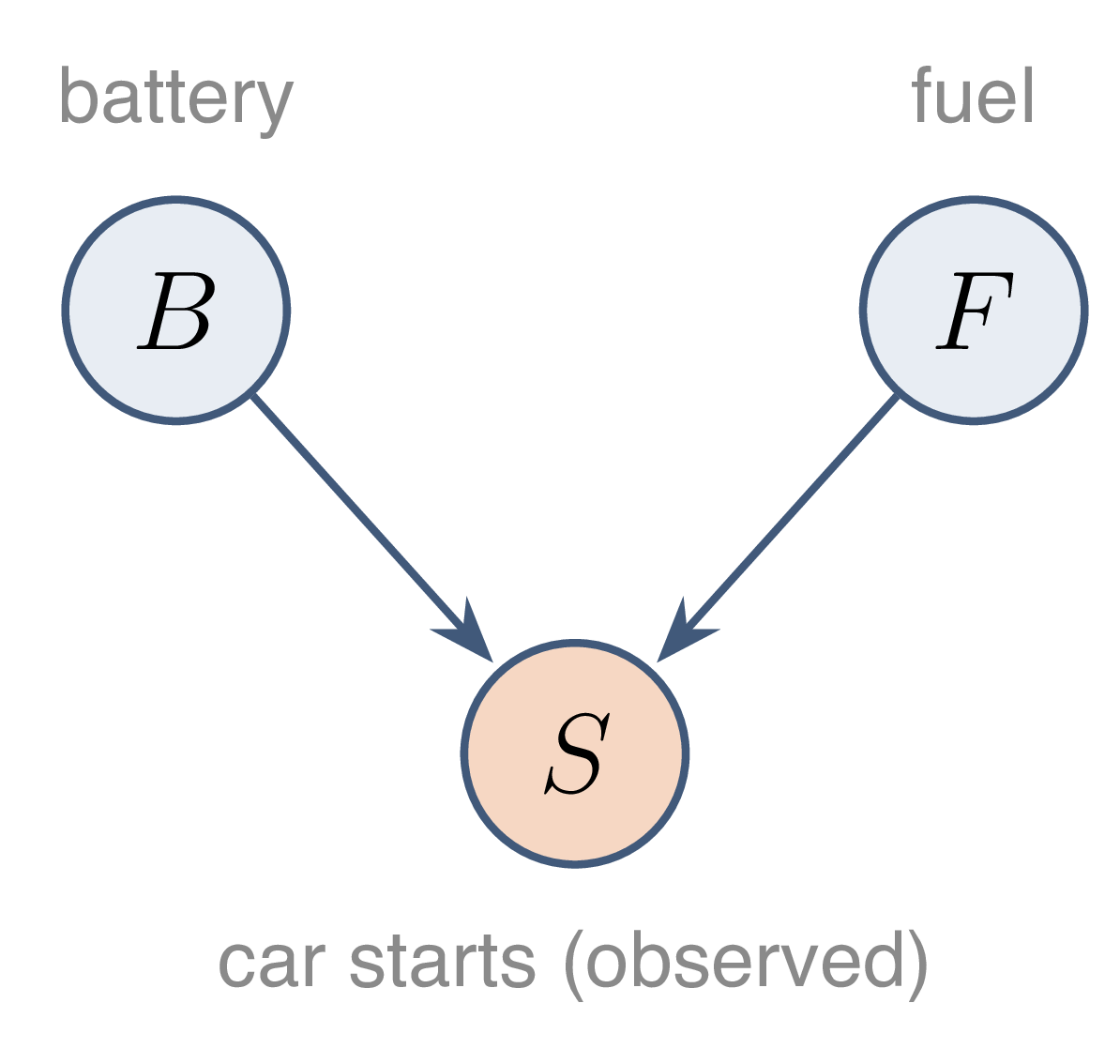
- Battery state \(\perp\) fuel level
- Car not starting + battery fine → empty tank
- Two independent causes, dependent given the common effect
Pearl (1988), Probabilistic Reasoning in Intelligent Systems.
Selection on a collider: Berkson bias
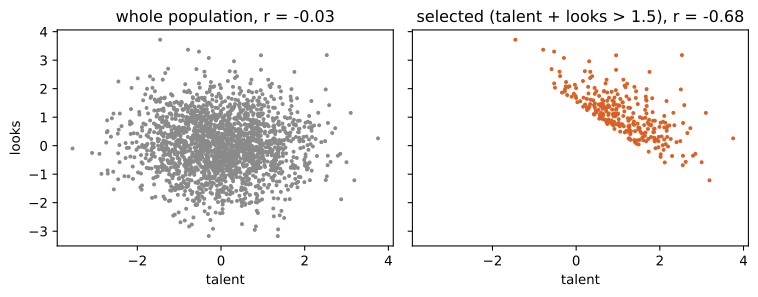
Selection = conditioning on a collider → spurious negative correlation.
Berkson bias as a collider
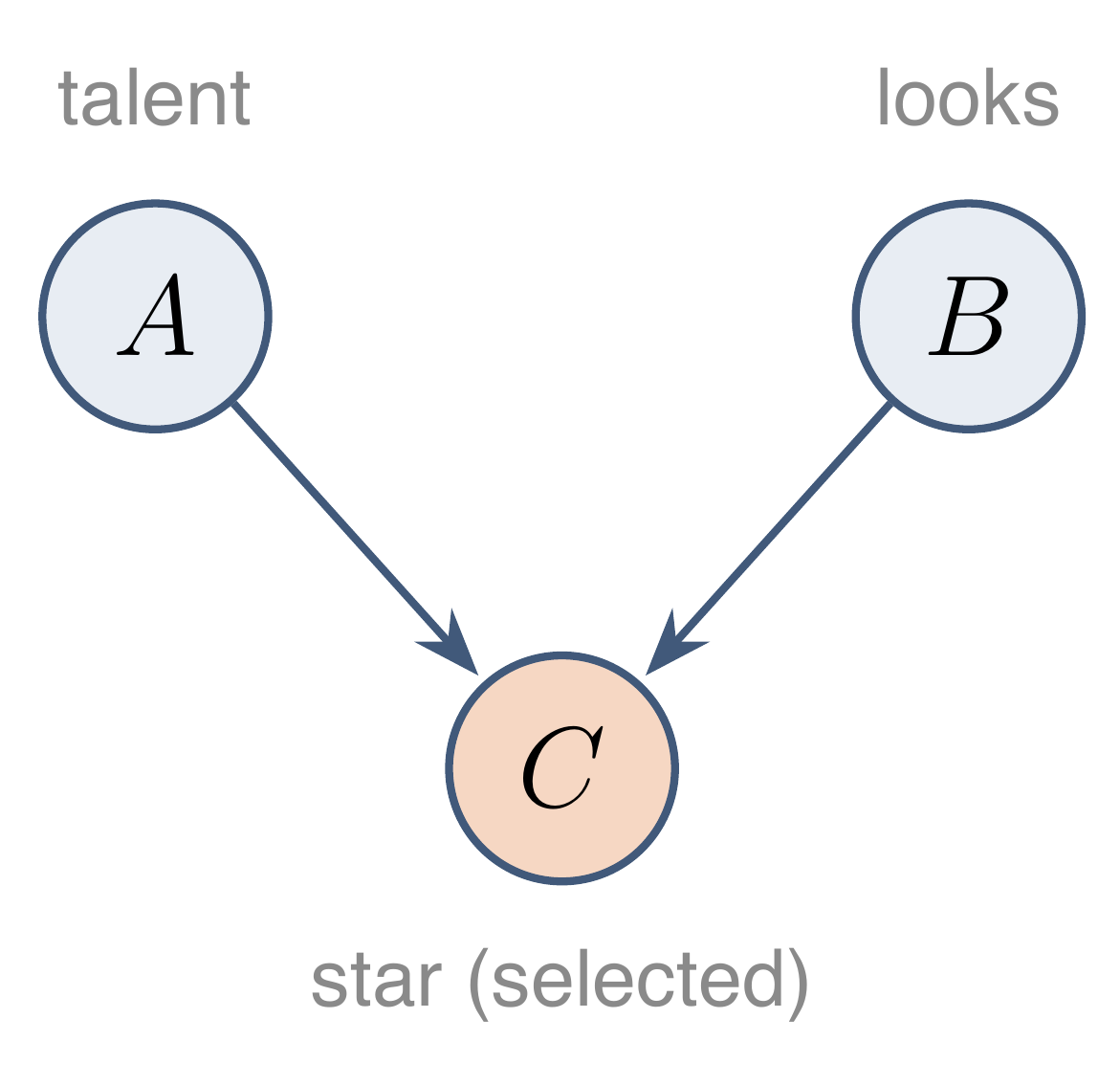
- \(A\), \(B\): independent causes of \(C\)
- Path blocked: \(A \perp B\)
- Selection on \(C\): \(A \not\perp B \mid C\)
- Low-talent star → high looks: \(r < 0\)
Selecting stars conditions on the collider and couples the two causes.
\[ p(a, b \mid C = 1) \propto p(a)\, p(b)\, \mathbb{1}\{a + b > 1.5\} \]
d-separation: worked example
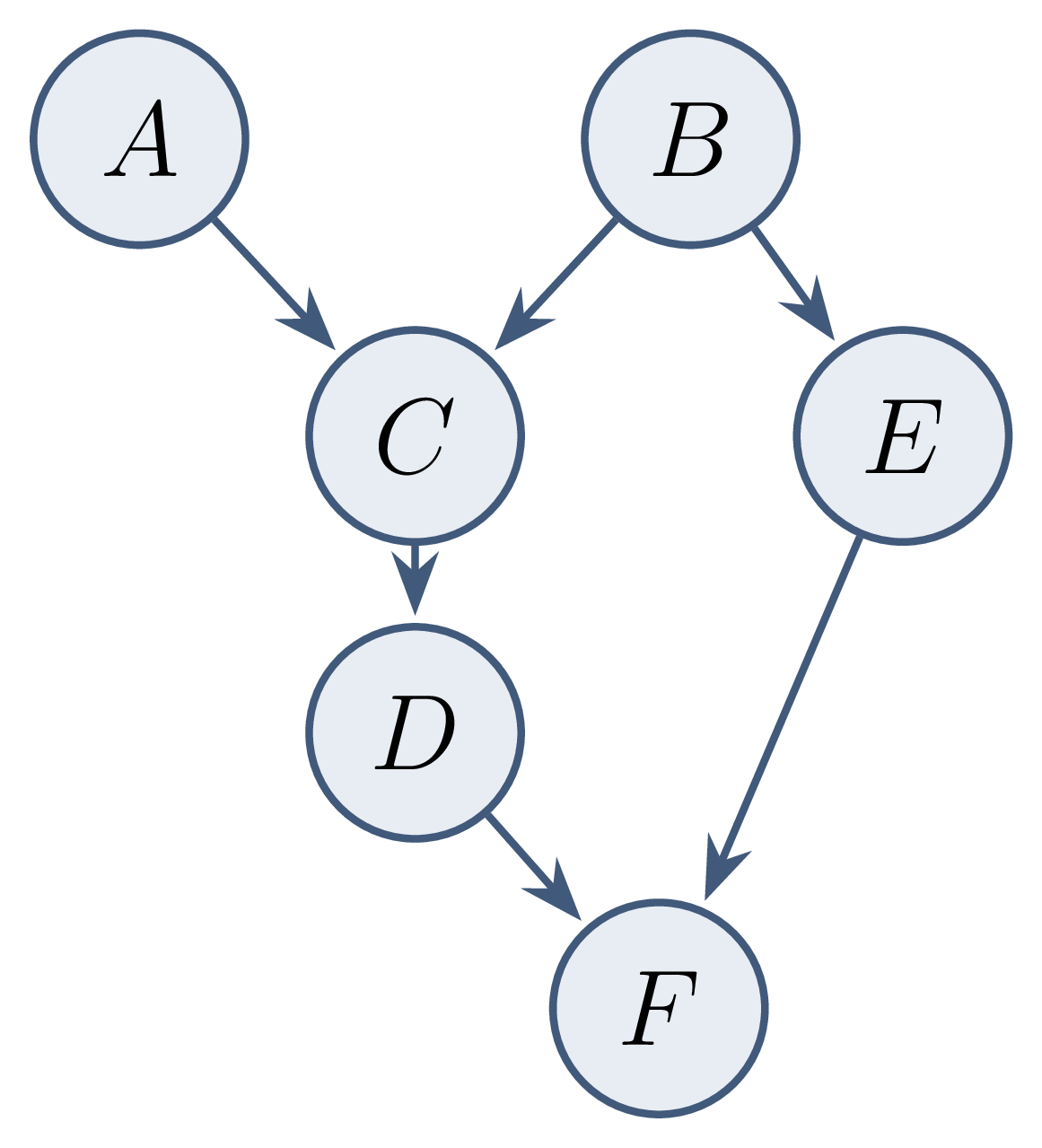
| Query | Answer |
|---|---|
| \(A \perp B\) | yes |
| \(A \perp B \mid F\) | no: \(C\) opened via \(F\) |
| \(A \perp E \mid C\) | no: \(A \to C \leftarrow B \to E\) |
| \(A \perp E \mid \{B, C\}\) | yes |
| \(D \perp E \mid \{B, C\}\) | yes |
Markov blanket
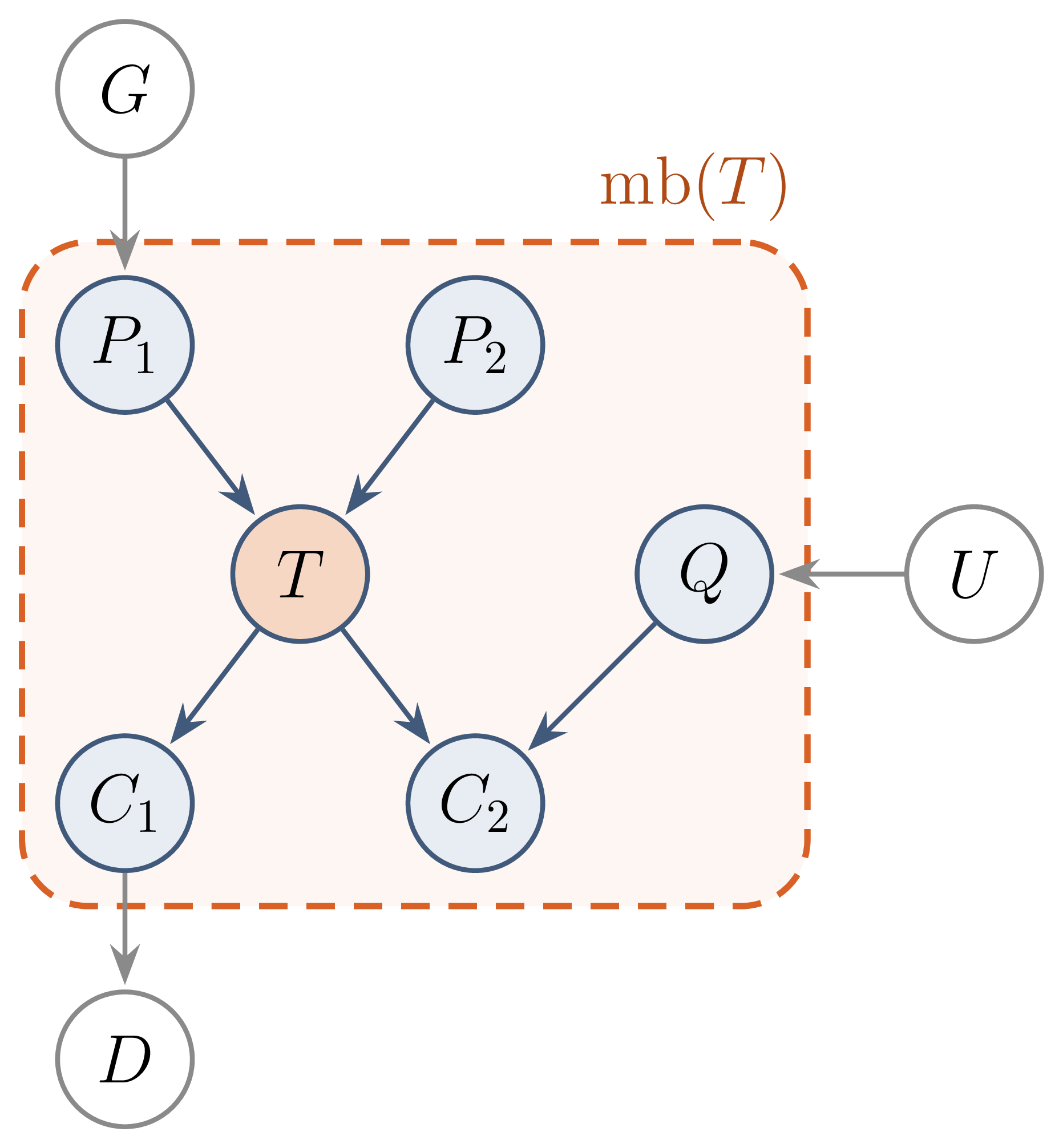
In a DAG, the parents, children and co-parents of a node make it independent of all other nodes: this set is its Markov blanket.
\[ mb(t) = \Big(pa(t) \cup ch(t) \cup \textstyle\bigcup_{c \in ch(t)} pa(c)\Big) \setminus \{t\}, \qquad X_t \perp X_{V \setminus (mb(t) \cup \{t\})} \mid X_{mb(t)} \]
Three nodes, two equivalence classes

- Chain, reverse chain, fork: same independence \(A \perp B \mid C\)
- Collider: \(A \perp B\), alone in its class
CPDAG: representation of a class
CPDAG (completed partially directed acyclic graph), or essential graph: a single graph standing for a whole Markov equivalence class, i.e. all DAGs encoding the same conditional independences.
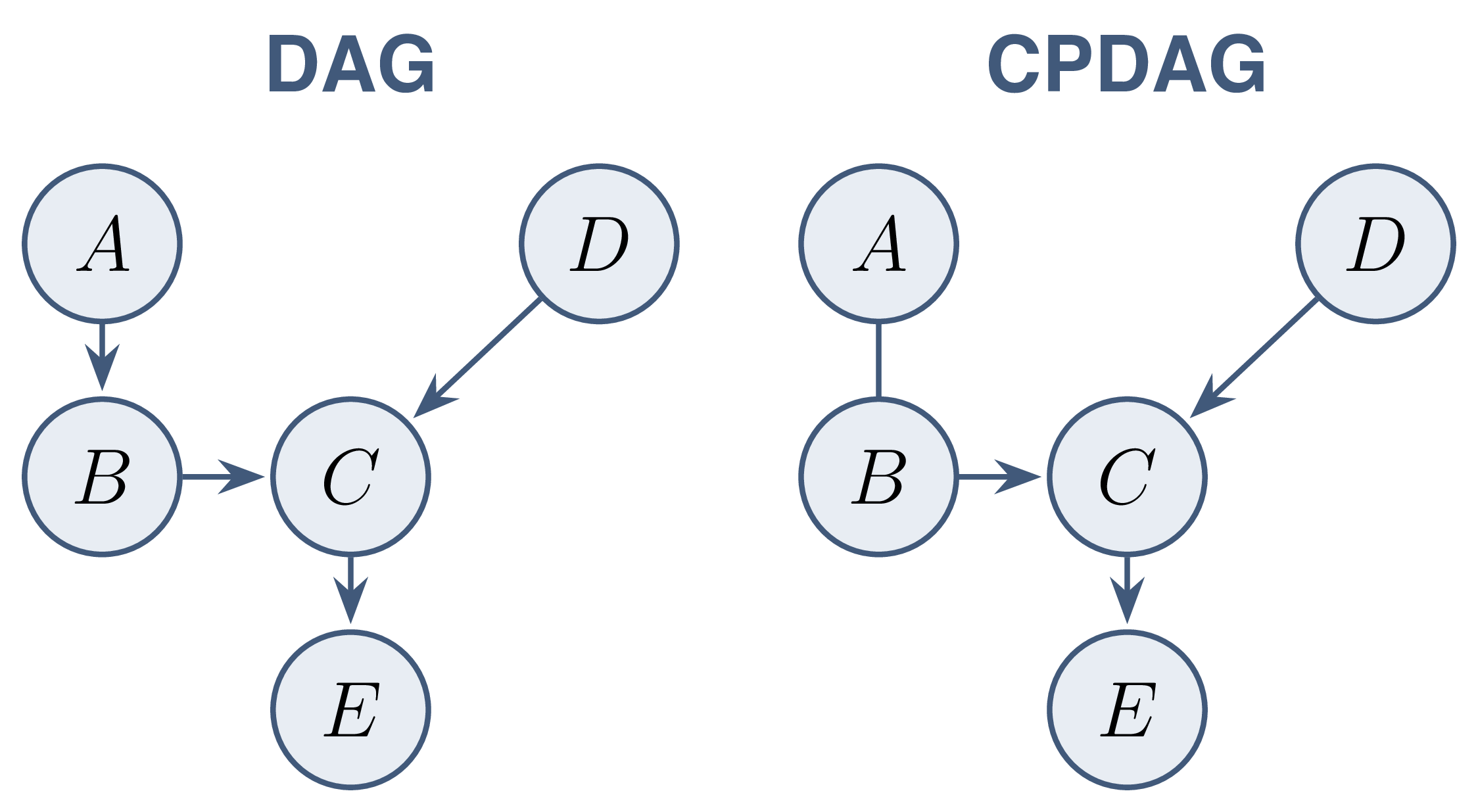
- Directed edge: same orientation in every DAG of the class
- Undirected edge: orientation varies within the class
- \(B \to C \leftarrow D\): v-structure; \(C \to E\): forced, else new v-structure